
Some time ago, I presented a pocket watch with dead beat seconds. Today I’m going to talk about a movement for wristwatches with this complication, the Chézard 116. Unfortunately, I can’t present a wristwatch with this movement, but I can present the following fob watch, a Dugena Saltofix, which is attached to workwear with a safety pin.
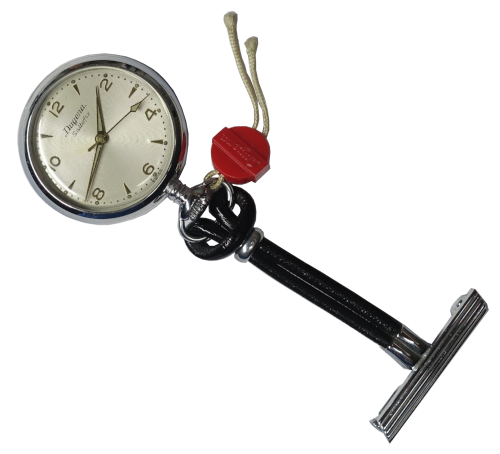
The name Dugena Saltofix is usually associated with men’s wristwatches featuring this movement. I have never seen the Dugena Saltofix as a fob watch before.
The following video shows the small watch with a diameter of 29.6 mm in action:
The red plastic seal bears the Dugena brand name on one side and the price at the time, 118 DM (German Marks), on the other. The watch probably dates from between 1955 and 1960.
Before we take a look at the movement, a few words about the Swiss manufacturer Chézard, of which little is known.
In 1929, David Mader established a workshop in Hauts Geneveys, Switzerland, which was moved to Chézard a few months later. Initially, jewel settings were produced there, and from 1931 onwards, movements (ébauches). Small movements for ladies’ watches were produced under the company name David Mader & Cie. In 1937, the company was affiliated with Ebauches SA, an association of numerous Swiss movement manufacturers, under the name Fabrique d’Ebauches de Chézard SA. In 1950, the company had 62 employees and produced 220,000 movements annually. From 1951 onwards, the company developed movements with jumping seconds, also known as Seconde Morte or Dead Beat Seconds. These were sold from around 1953 onwards and installed in watches by various manufacturers. These movements are rather rare and sought after by collectors. In 1969, the company was finally dissolved.

Let’s take a closer look at the Chézard 116. It bears the Chézard logo and the number 116 under the balance wheel. And on the ratchet wheel, the Dugena caliber designation 778. So far, no surprises. However, the logo of the movement manufacturer FHF (Fabrique d’Horlogerie de Fontainemelon) can also be found under the balance wheel! Did FHF supply the base movement or was it involved in the manufacture of the entire movement? Unfortunately, I don’t know. In any case, FHF was much larger than Chézard and was also a subsidiary of Ebauches SA.
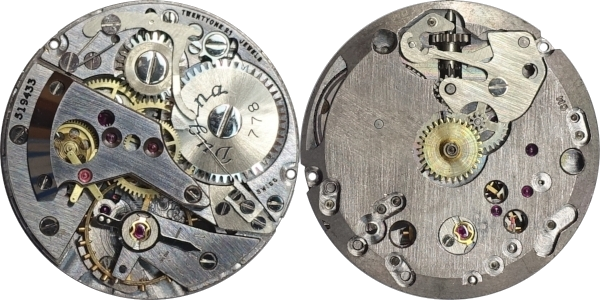
First, the technical data of the Chézard 116:
- Hour, minute, jumping central seconds with stop function by pressing the crown
- Diameter 11 1/2´´´ (French Lignes)
- Hand winding
- Swiss lever escapement
- 21 jewels
- Incabloc shock protection
- Monometallic screw balance
- 18,000 bph
- For further details and information on the entire movement family, see Chézard 116 = Dugena 778 – Watch Movements Archive
The following video shows the movement in action:
How does the jumping seconds feature work on the Chézard 116?
To understand this, we first remove the bridge under which all the relevant parts are located:

The jumping seconds wheel is located in the center of the movement. To its left are the parts that enable the jumping action:
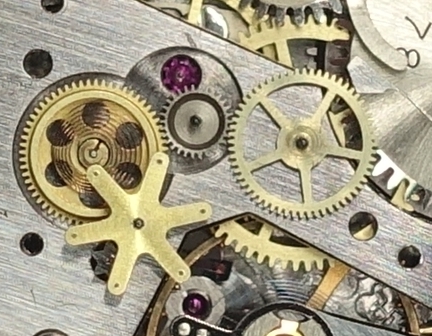
The gold-colored wheel with holes and a spiral, as well as the six-armed component next to it, are particularly striking. The gray wheel between the second wheel and the wheel with the spring is only an intermediate wheel with no further function. A small, star-shaped wheel with six spokes can be seen under the six-armed component:

The star-shaped wheel is pressed onto the escape wheel located under the bridge, meaning that it rotates with it. Similarly, the core of the wheel with the spring is pressed onto the fourth wheel. In this movement, however, the fourth wheel does not have a (small) seconds hand. The connection between these two wheels is made via the component with the six arms. On its underside there is a pinion that engages with the wheel with the spring, and a small pin on each arm.
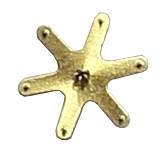
The pinion initially blocks the wheel with the spring and, via the aforementioned intermediate wheel, also the central seconds wheel. The rotating escape wheel ensures, via the six spokes, that the component with the six arms rotates one arm further after exactly one second. Its pinion rotates the wheel with the spring one tooth further. This causes the central seconds wheel to also rotate one tooth further via the intermediate wheel. The seconds hand therefore jumps forward by one second. In the image above, you can also see a small spring that engages with the central seconds wheel at the top right. This locks the wheel in place until the next jump of the seconds hand.
It all sounds very simple, but it isn’t!
The decentralized seconds wheel (for the small seconds) continues to turn continuously, so why doesn’t the wheel with the spring also turn continuously? Because this wheel hides two ingenious secrets!
The first secret is that the wheel and the spring at its center are not connected to each other, meaning they can rotate independently. Until the next second jump, the rotating decentralized second wheel only winds the spring a little. The wheel does not move because it is blocked by the pinion of the six-armed component. When this pinion releases the wheel for the next second jump, it rotates one tooth further. The slightly tensioned spring supports the rotation process through its connection to the outer edge of the wheel, and the spring relaxes again.
The second secret comes into play when using a special function of this movement. It has two different variants of a seconds stop. The first variant involves pulling the crown out completely. This stops the entire movement and allows the hands to be set to the exact second. The second variant involves pressing the crown. This is possible because it does not lie completely against the case. This moves a lever that presses against the spring that holds the central seconds wheel in position. This stops the seconds wheel, but the rest of the movement continues to run! The seconds hand can thus be stopped at 12, for example, in order to then measure the number of heartbeats over 30 or 60 seconds.

What does this have to do with the wheel with the spring?
While the central seconds wheel is blocked for a while by pressing the crown, the spring in the wheel with the holes continues to wind up. At some point, it should be fully wound up so that it can no longer turn. Since its core is pressed onto the decentralized seconds wheel, the latter should also no longer be able to move. The movement should therefore come to a standstill! The reason this is not the case is that the spring is not firmly connected to the edge of the wheel. Instead, the outer coil simply presses so tightly against the wall of the edge that it can carry the wheel along with it when the seconds jump. When the stop function is activated, it simply slips through at some point and the spring relaxes again. This means that the crown can be pressed for a longer period of time without the movement coming to a complete standstill. The principle is the same as that of the slip clutch of the mainspring in an automatic movement.
The idea of using a spring may date back to Swiss patent CH272327, entitled Mécanisme de seconde morte pour mouvement d’horlogerie (Dead beat seconds mechanism for a watch movement). This was filed by Ebauches SA in 1948 and granted in 1950:
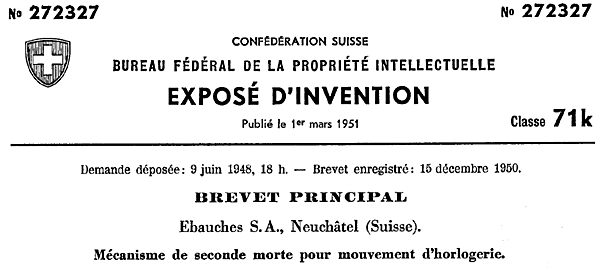

However, some of the components used in the Chézard 116 jumping seconds mechanism are not listed in this patent.
Patents with the same content were also granted shortly afterwards in Germany (DE818477) and the US (US2580597). Fritz-André Robert-Charrue is named as the inventor on both of these patents. He worked for Ebauches SA, but I was unable to find out whether he had any direct connection to Fabrique d’Ebauches de Chézard SA.