
Today, I am once again stepping onto thin ice. Just like in my article about Oiling Watch Movements. As with oiling, every watchmaker and watch enthusiast has their own philosophy when it comes to cleaning watch movements. Here, I describe a method that has proven itself to me as a hobbyist for many years. It makes no claim to be universally valid!

Professional watchmaker vs. hobbyist
There are a few significant differences between professionals and hobbyists when it comes to cleaning watch movements.
Firstly, professionals need to work efficiently and economically, whereas this is not an issue for hobbyists. For this reason, professionals will purchase a fully automatic watch cleaning machine, which ideally allows them to clean several movements at the same time. These devices usually combine ultrasonic cleaning with mechanical movement (rotation and/or vibration), possibly including heating, and even dry the movements and recondition the cleaning solution.
However, we are talking about purchase costs that often run into five figures.

Secondly, professionals usually do not use water-based cleaning solutions, but rather flammable solvents, which must be used and disposed of properly. They prevent possible corrosion from residual water and dry faster. Hobbyists tend to try to minimize or completely avoid the use of solvents.
And thirdly, if professionals do not use water-based solutions for cleaning, they can clean the movements without disassembling them or only partially disassembling them. If there are no defects or wear and tear in the movement, this naturally speeds up the overhaul process considerably, as the movement does not have to be disassembled and reassembled, but can be oiled and regulated immediately after cleaning.
I always take the movements apart. Not only because I use an water-based cleaning agent, but also because I want to identify any potential defects as early as possible.
Cleaning for hobbyists—one of many possibilities
In addition to large cleaning machines for professionals, there are of course smaller versions available. And hobbyists have the option of purchasing older devices from watchmakers. There are also numerous creative homemade versions out there.
Personally, I find such devices too large, and I would rarely use them. My personal approach is therefore based on a standard small ultrasonic cleaner, which can also be used for all kinds of other purposes at home. A capacity of around 500 ml is perfectly adequate.
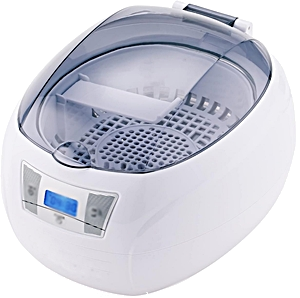
I clean the watch parts with Elma Red 1:9. The advantage of this for hobby watchmakers is that it is an water-based solution that can be disposed of with the wastewater. One part of the Elma solution is mixed with nine parts lukewarm water and placed in the ultrasonic device.
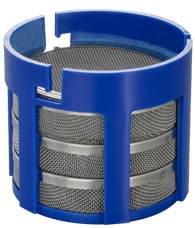
The movement parts are not placed directly into the device, but rather into small mesh baskets, in which related parts are separated from each other by dividers.

These can also be stacked in a holder:
A few tea strainers will also do for starters!
What can be cleaned with ultrasonic cleaning and what cannot?
- Painted or color-marked or coated parts should not be cleaned. These include, for example, dials, hands with luminous material, and date discs.
- To be on the safe side, I clean plastic parts by hand, as the cleaning solution may damage the plastic.
- I also place the balance and the pallet fork in the ultrasonic bath. Theoretically, there is a risk that the shellac fixing of the pallet fork or the impulse jewel could come loose. In practice, this has never happened to me. I suspect that the power of the small ultrasonic devices is far too low for this to happen. However, I can imagine it happening with large industrial devices.
- I also put the mainspring in the ultrasonic bath. To do this, it is always removed from the barrel.
- All other parts such as wheels, bridges, screws, the mainspring barrel, etc. should, of course, be placed in the ultrasonic cleaner.
The parts remain in the ultrasonic cleaner for about five to ten minutes, depending on how dirty they are. During this time, I occasionally move the baskets or the entire device back and forth a little to create some mechanical movement. The parts are then rinsed first with normal tap water and then with distilled water. Finally, the parts are simply dabbed dry with paper towels. However, these should be of good quality and lint-free.
Parts in which water may remain are then placed in a small glass containing Elma SUPROL PRO, a solvent that displaces water, for about three minutes. These are usually the balance, the balance cock, and the base plate. After removal from the glass, the residues on the parts evaporate very quickly and usually without leaving any residue (open the window!). A lint-free cloth removes any residue that may be visible as a slight haze.
Elma Suprol must not be disposed of down the drain! However, only very small amounts accumulate, which can be taken to the recycling center.
To be on the safe side, I usually leave the parts to dry at room temperature for a day.
Reassembly, oiling, and adjustment after cleaning
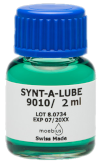
Reassembly of the movement is simply done in reverse order of disassembly. For more complicated movements, such as chronographs, it is worth photographing each step during disassembly!
I have described my personal preference for oiling here: Oiling Watch Movements
And finally, the movement must of course be adjusted: Regulating a watch movement for beginners