
Many watch movements have a seconds stop. When the crown is pulled out to the position for setting the hands, this ensures that the second hand stops. This allows the time to be set to the exact second. When the crown is pulled out, the second hand naturally remains where it is.
The Longines 6942 is completely different. Here, it always continues running until the 12 o’clock position and stops exactly there. This complication is also called zero-reset seconds.
The Longines movement was used from 1974 onwards in models such as the Admiral HF and Conquest. My movement came to me without a case, which was probably melted down.
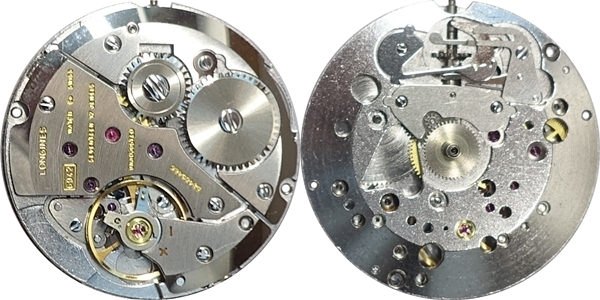
Technical data of the movement:
- Display of hours, minutes, central seconds
- Hand-wound
- Power reserve approx. 40 hours
- 17 jewels
- Diameter 12 1/2´´´ (French lines) = 28.2 mm, height 3.85 mm
- 28,800 beats/hour (bph)
For its time, this was a ‘high-beat’ movement. - Swiss lever escapement
- Glucydur balance, Spirofin fine regulator
- Part of the Longines 69xx movement family, which also includes variants without seconds, with small seconds, with date, and with day and date.
So let’s take a look at how Longines has implemented the seconds stop function. First, let’s look at the dial side:
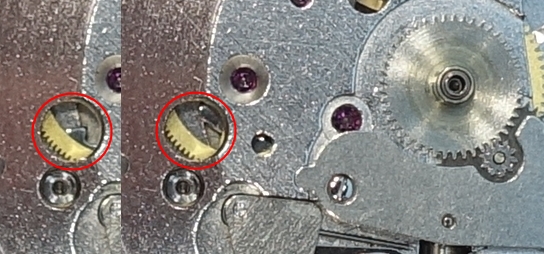
In the opening marked in red, you can see a small lever that moves when the crown is pulled (right-hand image). Unfortunately, nothing else can be seen from this side. So let’s take a look under the wheel train bridge on the bridge side of the movement:
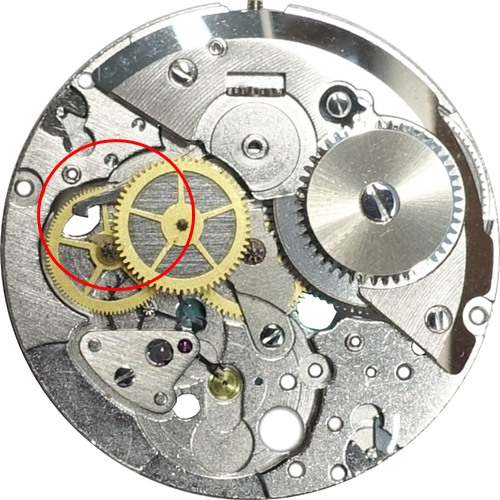
The lever is easier to see here. It is located directly above the seconds wheel. However, this does not have a seconds hand, as the movement has an indirect center seconds function, whose seconds pinion is driven by the third wheel.
There’s a bit more to see if you also remove the third wheel and the barrel bridge:
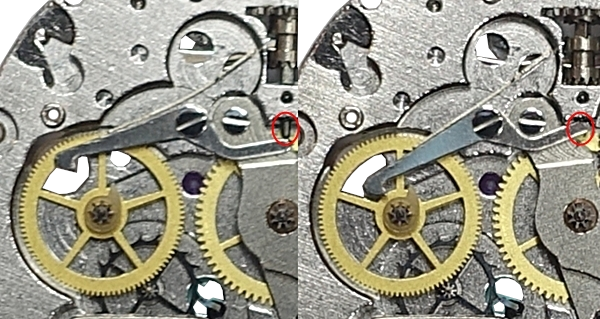
In the left-hand image, the crown is pressed down and the pinion of the winding stem pushes down the right arm of the lever at the point marked in red. Accordingly, the left arm of the lever is close to the outer edge of the seconds wheel.
In the image on the right, the crown has been pulled out, meaning that the pinion of the winding stem is no longer pressing against the right arm of the lever. A thin spring on the outside of the left arm pushes it toward the center of the seconds wheel. The seconds wheel continues to run until the lever catches on the “nose” of the seconds wheel. The movement therefore stops at this precisely defined point.
A pretty simple solution for the seconds stop at 12 o’clock! However, this technique never caught on. In my opinion, this is for the following reasons:
- The advantage over the classic seconds stop is negligible in practice. Even with this, you can stop the seconds fairly accurately at 12 o’clock. And tenths of a second hardly matter in a mechanical watch.
- Setting the second hand is very tedious. Due to the indirect driving of the central seconds, the seconds pinion has minimal amount of clearance. When setting the second hand, this leads to slight shifts, so that the next time it stops, it is not exactly at 12 o’clock, but slightly off. It took me at least 20 attempts before I was able to shoot the video above.