
The Swiss watch manufacturer La Terrasse Watch is largely unknown. Since the company also developed and manufactured its own movements, it is worth compiling the little that is known about it here.

The company’s history
I was not able to determine the exact date the company was founded. Some sources claim that the company was founded in 1881 by the brothers Bernard and Gustave Jacot. Unfortunately, the Swiss Official Gazette of Commerce (SOGC), which records many company registrations and changes, was not established until 1883. As a result, I was unable to determine whether the company founded by Bernard and Gustave Jacot was already operating under the name La Terrasse at that time.
The first documented evidence of the name La Terrasse appears in the SOGC in December 1901:
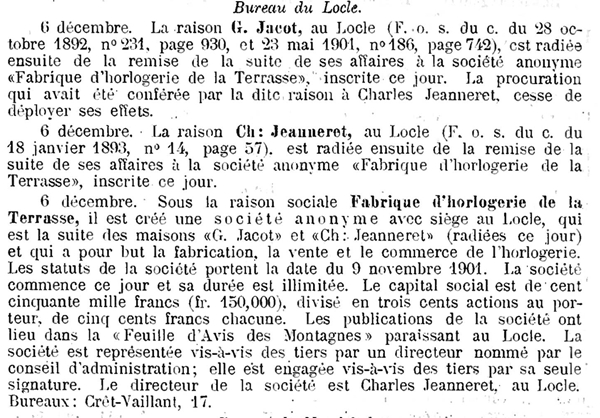
Gustave Jacot and Charles Jeanneret dissolved their own companies on the same day and jointly founded the Fabrique d’horlogerie de la Terrasse retroactively as of November 9, 1901. Charles Jeanneret took over as director. Based on the above information about Gustave Jacot, the SOGC also reveals that his company emerged from the Société Jacot Frères in 1892. This company, in turn, was founded in 1883 and was located in the Crêt Vaillant district of Le Locle at the Fabrique de la Terrasse. The term La Terrasse can thus be traced back to at least 1883, albeit not as a company name.
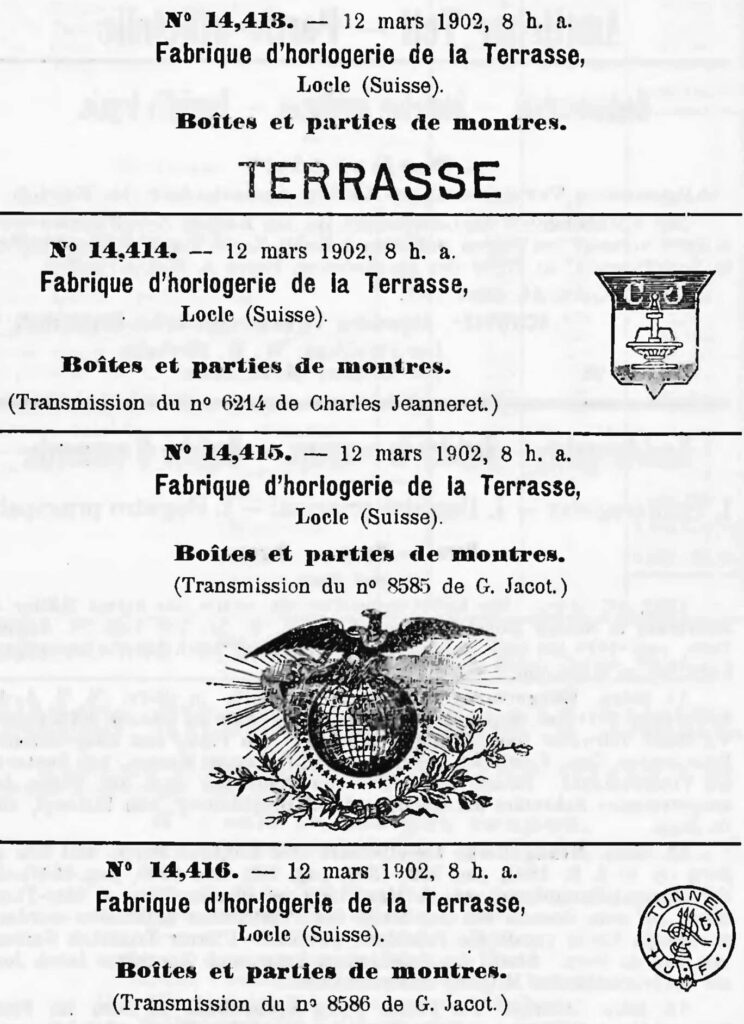
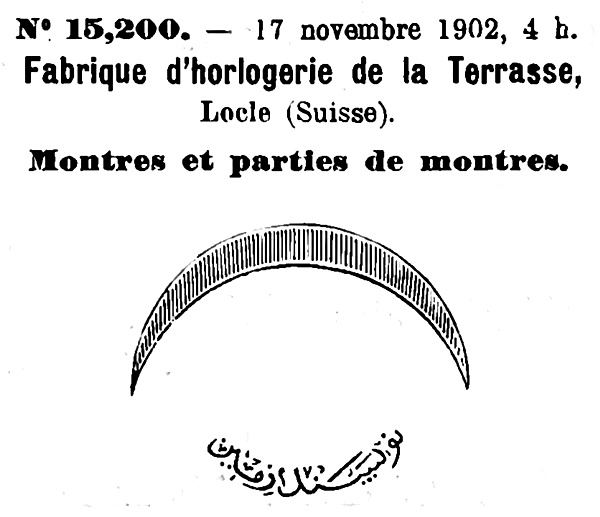
As early as 1902, the Fabrique d’horlogerie de la Terrasse registered the following pictorial trademarks, including TERRASSE and TUNNEL. Some of the trademarks were transferred to the new company by Gustave Jacot and Charles Jeanneret, respectively.
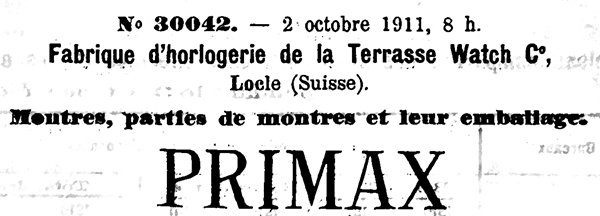
Another pictorial trademark, PRIMAX, was registered in 1911:
It wasn’t until 1924 that the NORØNNA and SVEA brands followed:

In 1909, the company was renamed Fabrique d’horlogerie de la Terrasse, Watch Co. Then, in 1918, it became Terrasse Watch Co. S.A. At the same time, the company’s scope of business was expanded from watchmaking to include “similar items and small mechanical components”. In 1922, the company announced that its board of directors consisted of no fewer than seven members. Among them were Alfred, Henri, and Paul Pister. We’ll come across the name Pfister again shortly!
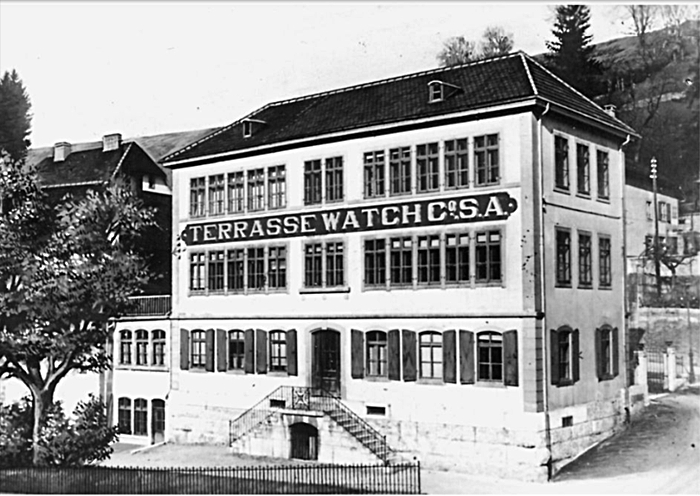
Apparently, the company was quite successful, as it had a nice office building by 1925:
The company also appears to have come through the turmoil of World War II in good shape. In December 1944, the SOGC reported that Terrasse Watch Co. S.A. had established a foundation for the benefit of its employees and their families:
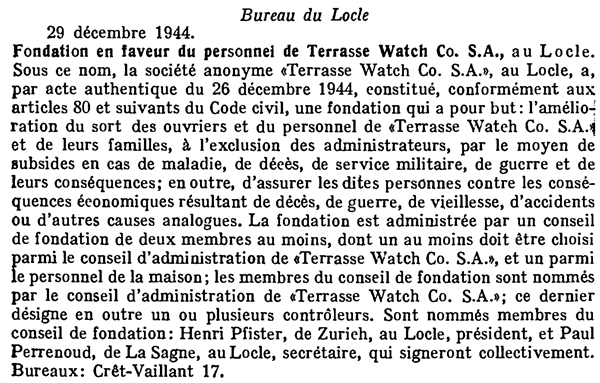
This foundation was not dissolved until 1974.
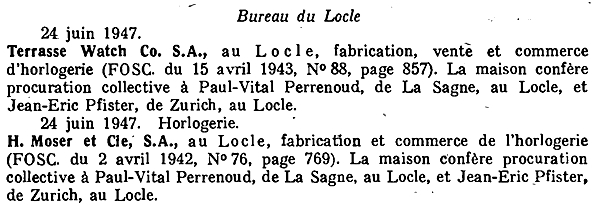
In 1947, there is a very interesting entry in the SOGC: on the same day, the companies Terrasse Watch Co. S.A. and H. Moser & Cie. S.A. each granted joint power of attorney to the following individuals: Paul-Vital Perrenoud and Jean-Eric Pfister. Unlike Terrasse Watch, H. Moser is a highly renowned and well-known company.
In 1952, new information emerged regarding the board of directors of Terrasse Watch Co. Henri Pister was appointed president, Eric Pfister (presumably Jean-Eric) became a director, and Frédéric-Emile Pfister joined the board. Paul-Vital Perrenoud was also on the board. At the same time, these same individuals held the same or similar positions at H. Moser et Cie. S.A.

It therefore appears that H. Moser and Terrasse Watch Co. had maintained close business ties for quite some time. When we look at the movements, we will see that H. Moser also used movements from Terrasse Watch.
It wasn’t until 35 years later – in 1987 – that another entry appeared in the SOGC. This entry concerns both Terrasse Watch Co. and H. Moser & Cie. Both companies, along with other watch manufacturers, had been integrated into Zenith Internationale S.A.:

Terrace Watch Co. S.A. was officially dissolved in December 1988. It is surprising that this company existed for about 100 years and yet remained virtually unknown.
The Watch Movements
Let’s now take a look at the movements made by Terrasse Watch Co. Their designs have also been registered, at least in part, in the SOGC.
The first movement is listed in 1911 as model no. 165. Why the company chose the number 165 of all things will likely remain a mystery, since the SOGC did not specify any requirements in this regard. The illustration shows the Savonnette version. At the time, it was common practice to show only the Lépine (open face) or the Savonnette (hunter) variant; the other variant was thus implicitly registered as well.
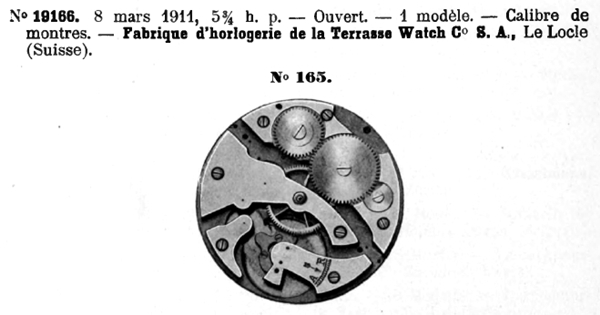
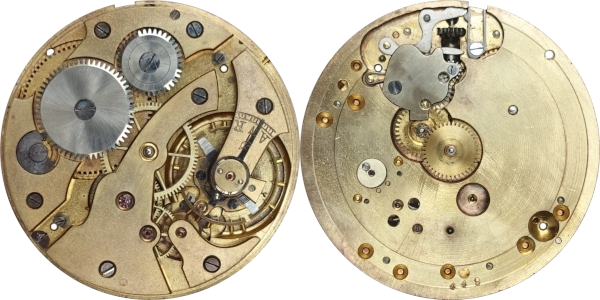
My collection includes the Lépine version of model no. 165. It has a diameter of 19´´´ (French lines), a Swiss lever escapement, 15 jewels, and a small seconds.
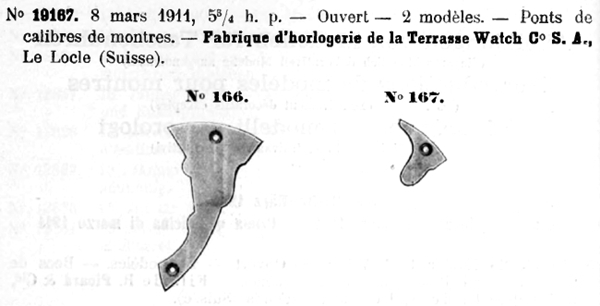
On the same day, the company also registered the center wheel bridge and the escape wheel cock of model no. 165 as models no. 166 and 167:
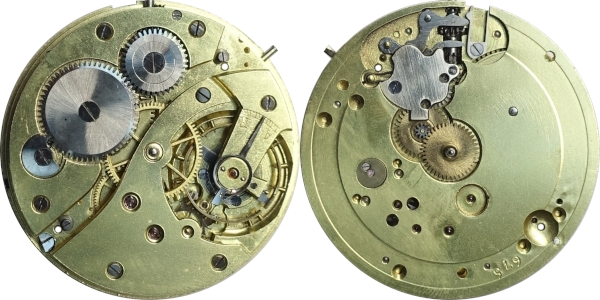
The following Lépine movement is technically almost identical to model no. 165, but has different bridge designs. I was unable to find any record of it in the SOGC.
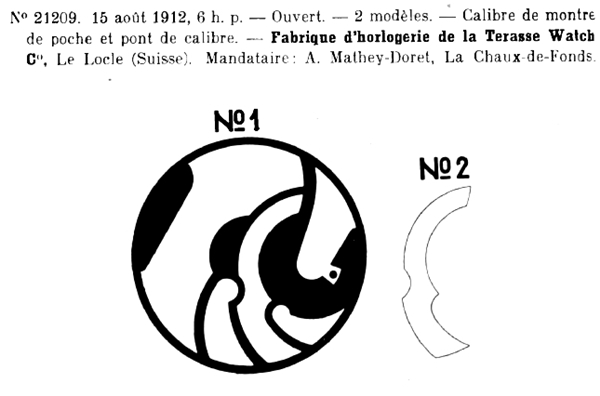
In 1912, the movement model no. 1 and the corresponding center wheel bridge (model no. 2) were registered. Why the numbering suddenly continued with No. 1 here will also remain a mystery.
I can show both the Savonnette and the Lépine versions of this movement. Both have a diameter of 19´´´, a Swiss lever escapement, 16 jewels, and a small seconds. In the Lépine version, the center wheel jewel has a screwed-in setting (Chaton). Incidentally, the H. Moser logo can be seen on the bridge side of the Savonnette movement (top image), though unfortunately only faintly.
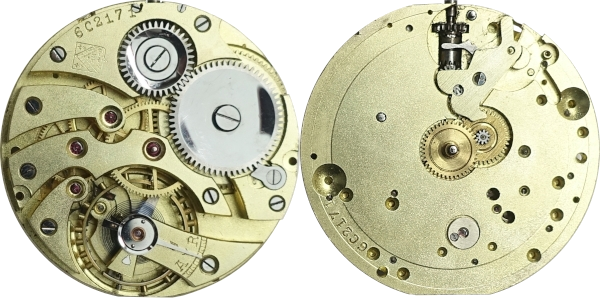
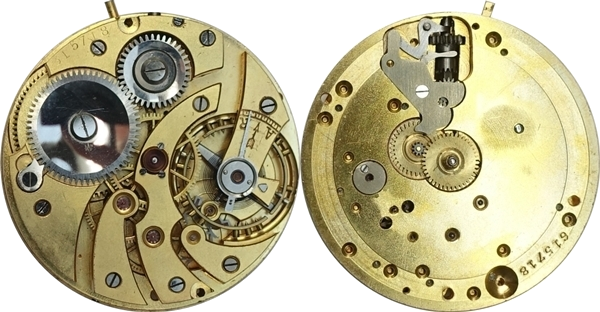
There is an interesting entry regarding Terrasse Watch Co. in the December 1915 issue of the SOGC in relation to the Berner-Deckelmann company:

It granted Terrasse Watch Co. a partial license for movements that it had registered under its own name in 1914 and 1915:
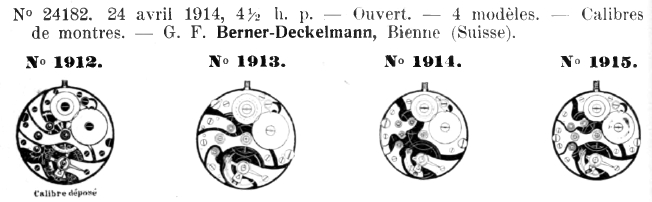
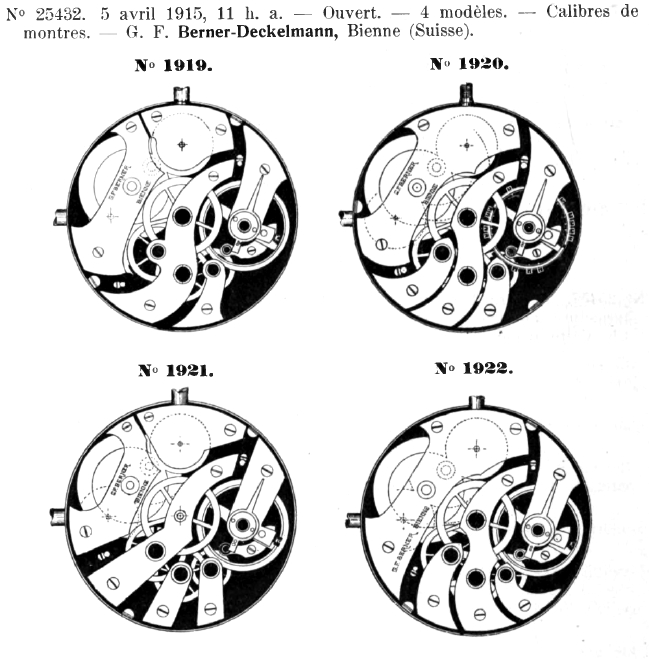
The similarity between some of Berner-Deckelmann’s movements and the Terrasse Watch model no. 1 is quite obvious. But why is Berner-Deckelmann granting a license to the Terrasse Watch here, and not the other way around? It is possible that Berner-Deckelmann violated the Terrasse Watch’s registered design with his movements and then granted the license to its own movements to avoid a legal dispute. But that is speculation!
So the number of movements made by Terrasse Watch Co. is quite small. But perhaps I’ll come across another variant someday that isn’t listed in the SOGC.