
Repeaters are fascinating complications in watch movements. They were particularly popular around 1900, naturally in pocket watches. And today, a number of haute horlogerie manufacturers are once again offering them in wristwatches. Classic variations of this complication include the quarter-hour and minute repeaters. The 5-minute repeater, on the other hand, is very rare.

The movement presented here dates from the quartz crisis of the 1970s, which marked the beginning of the decline of mechanical movements. It was an attempt to offer a high-end mechanical complication at a relatively affordable price.
The pocket watch shown here bears the brand name Lido. Since this name was used by several companies, I was unable to determine its exact origin.
The back of the pocket watch looks very ordinary:

After removing the snap-on bottom cover, a little surprise is revealed – in the truest sense of the word:

A tiny watch movement surrounded by a decorative grid that can be easily removed:

The movement is an ETA 2801 with a diameter of approximately 26 mm. Beneath it, you can see a significantly larger movement plate. It supports the repeater module mounted on the base movement and has a diameter of 35.6 mm. This also increases the movement’s height to a total of 7.0 mm. However, there is still plenty of room within the pocket watch’s 57.3 mm diameter!
The repeater module was developed in 1975 by Dubois-Dépraz on behalf of Kelek. Kelek held the exclusive right to use the module in watches and to sell it to third parties, such as Angelus. Chronoswiss and Nivrel also used this module in wristwatches in the 1980s, though based on an automatic movement, the ETA 2892.
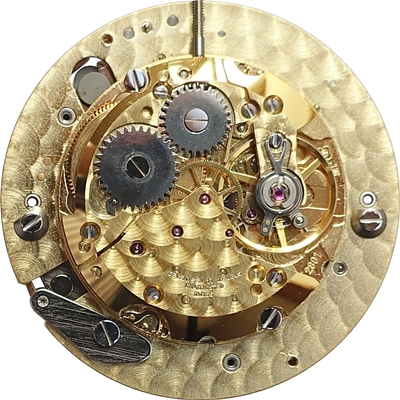
On the bridge side of the movement, not much of the repeating module is visible after it has been removed. At approximately 8 o’clock in the image, you can see the lever for triggering the repeater, which is actuated by the pusher on the case. And at approximately 11 o’clock, in an opening, there are two gray discs stacked one on top of the other. These are the hammers that strike the gong spirals on the dial side.
The dial side contains all the key components of a repeater. However, this article will focus only briefly on the technical aspects. I have described those in detail here: Funktionsweise einer Repetition (sorry, only available in German!).

The two gong spirals are located on the outer edge, and at the 1 o’clock position are the round hammers mentioned earlier, which strike them.
At the 12 o’clock position, you can see the repeater barrel, which is wound by pressing the repeater push button. This ensures that the repeater functions even when the movement itself is not running. At 10 o’clock is the centrifugal governor, which ensures that the chimes do not follow one another too quickly, and at the same intervals. The large hour star at approximately 7 o’clock, along with the hour snail below it, determines the number of hours to be chimed. For the 5-minute chimes, a 5-minute snail is also required, which is hidden at the location marked in red in the following image.

Incidentally, the repeater module does not have any jewels. This is also the case with many older repeater mechanisms, since the repeater is used only occasionally and no significant forces act on its bearings.
The following video shows the disassembled repeater in action: