
Bayern Praecision, sometimes also spelled Bayern Praezision, was a brand of Bayerische Taschenuhrenfabrik Lichtenfels GmbH (Bavarian Pocket Watch Factory Lichtenfels Ltd.), which was founded in Lichtenfels, Germany, on December 31, 1922.
So, pocket watches with movements from Bavaria? Yes, and the movements are something truly special—not to mention rather unusual!
The company
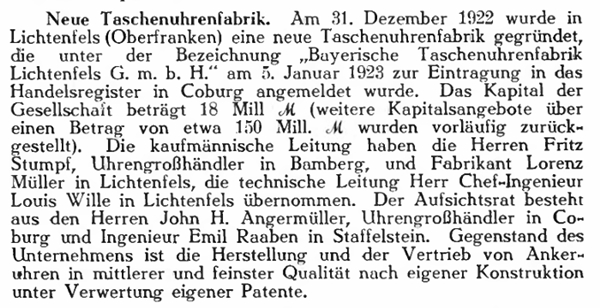
The company had two commercial directors, Fritz Stumpf and Lorenz Müller, as well as a technical director, Louis Wille. Louis Wille was no unknown figure in the world of watchmaking. The Deutsche Uhrmacher-Zeitung (German Watchmakers’ Journal) reported on him in 1929:
He was born on May 4, 1865, in Ammendorf near Halle.
Rarely has a professional career been as diverse as that of this colleague. From an early age, he worked on precision timepieces, watches for scientific purposes, and a wide variety of design projects. According to his own accounts, in 1897, for example, he created a clock featuring world times, a calendar, seasonal indicators, chimes, oratorio music, and more, which had 150 hands.At the turn of the century, he was awarded an honorary prize for his work in training watchmaking apprentices. He obtained 19 German patents for his inventions and designs. He received 1,250 timekeeping certificates for the fine adjustments he performed on watches. He was awarded the gold medal at an industrial exhibition in Leipzig. As a regulator, designer, or operations manager, he worked for, among others, Dencker, Hamburg; I. W. C. Schaffhausen; Omega, Biel; Huber, Munich; Gebr. Thiel, Ruhla; Bayerische Uhrenindustrie, Lichtenfels; Drusenbaum, Pforzheim; Wempe, Hamburg; and others.
Numerous articles about his work have appeared in the trade press. He himself has also authored a large number of technical articles.
So this man was obviously a very talented and energetic watchmaker!
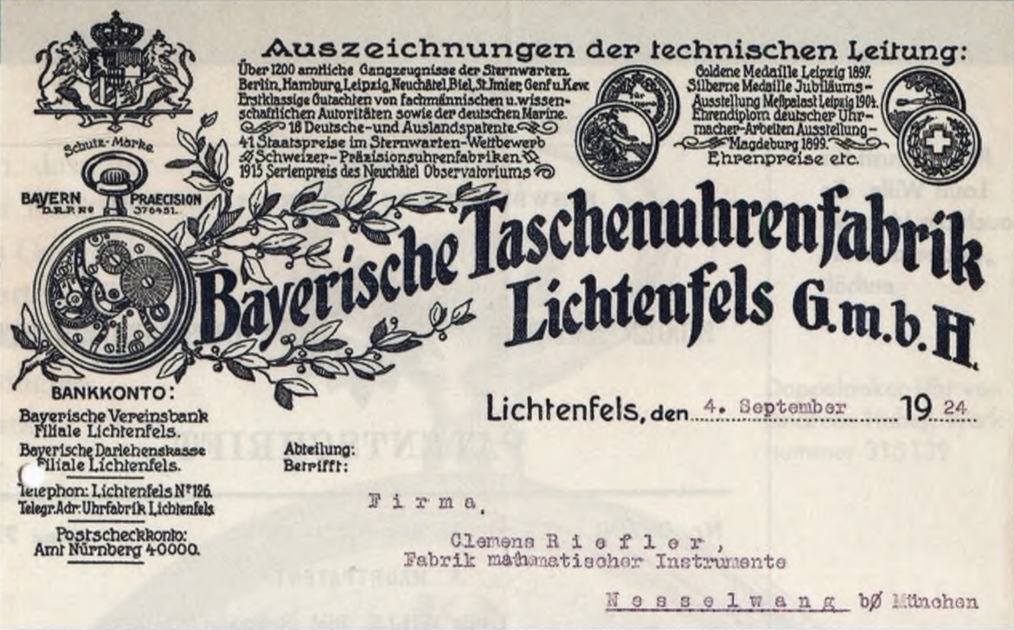
In 1925, the GmbH was dissolved, but operations continued on a larger scale as Bayerische Uhrenindustrie A.G (Bavarian Watch Industry, Inc.). The company initially appeared to be quite successful, employing some 70 people around 1925. In 1932, the company was forced to file for bankruptcy as a result of the Great Depression. Louis Wille remained in charge of technical operations until the company’s closure.
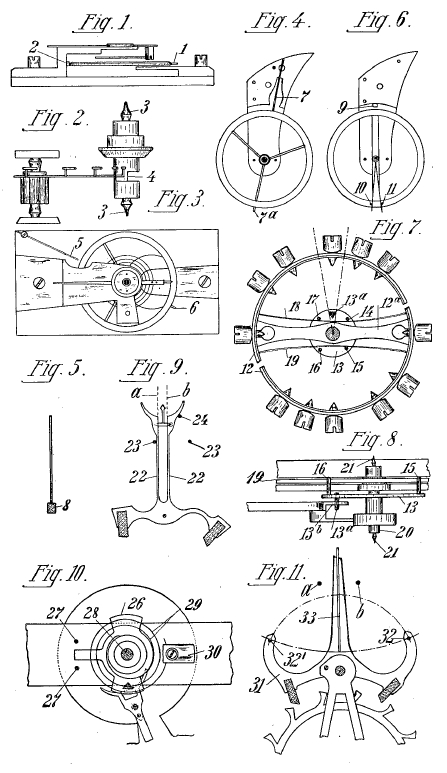
To honor his work, here are a few examples of his patent applications in Germany and Switzerland related to watch movements:
- DE144687: Torsionspendel mit Kompensation (Torsion pendulum with compensation), 1902
- CH52929: Unruhbalancier mit Kompensationseinrichtung (Balance wheel with compensation mechanism), 1910
- DE244910: Bruchsicherung für Drehpendelfedern (Breakage protection for torsion pendulum springs), 1911
- CH59064: Unruhbalancier mit Kompensationseinrichtung (Balance wheel with compensation mechanism), 1911
- CH68208: Einrichtung an Hemmungen von Unruheuhren, zum Zweck, die Erhaltung der Regulierung zu sichern (Device for escapements of balance wheel watches, designed to ensure the maintenance of regulation), 1911
- CH68210: Kompensations-Balancier für Taschenuhren (Compensating balance wheel for pocket watches), 1914
- CH75789: Einrichtung zur Vermeidung von Überspannungen und Brüchen beim Aufziehen von Federkraftwerken, insbesondere Uhren (Device for preventing over-winding and breakage when winding spring-driven mechanisms, particularly watches), 1916
- DE376451: Hilfskompensation für geschlossene einmetallische Unruhen in Verbindung mit überkompensierten Spiralen (Auxiliary compensation for closed monometallic balance wheels in combination with overcompensated hairsprings), 1922
- DE598553: Geräuschlos gehende Uhr (Silent-running watch), 1932
The watch movements
The Bayerische Taschenuhrenfabrik Lichtenfels specialized in modern manufacturing processes, particularly the production of plates, bridges, and cocks for watch movements, as well as cases produced using precision injection molding. In watchmaking, dimensional accuracy in the range of a few hundredths of a millimeter is required. Was injection molding supposed to be able to achieve this reproducibly as early as 1925? Let’s see…
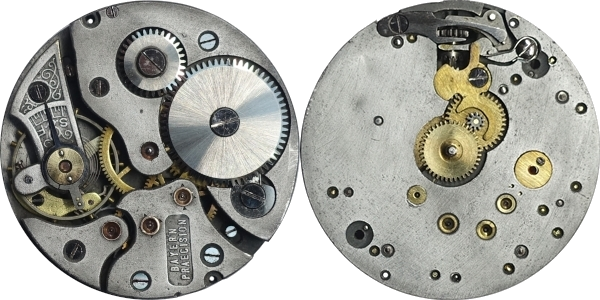
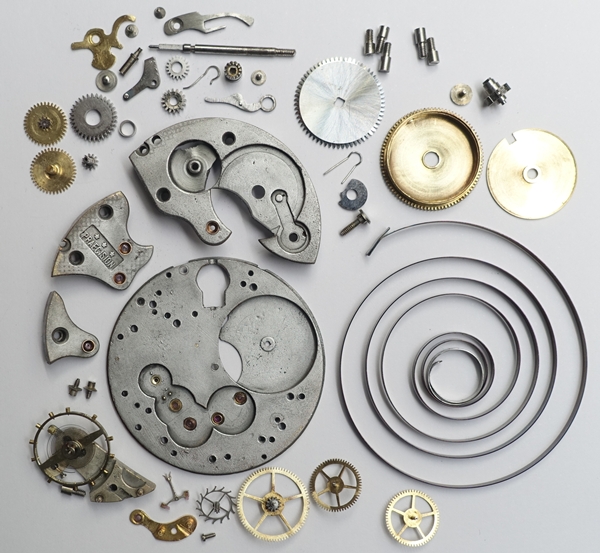
The movement has a diameter of 17 3/4´´´ (French lines), a monometallic screw balance with a flat hairspring, small seconds, and 7, 15, or 16 jewels. The image at the very top shows the movement in disassembled condition.
The movement appears to exist only in a Lépine (open face) version. At least, I have never come across a Savonnette (hunter) variant. More on this a bit further down.
The plates, bridges, and cocks of these movements were injection-molded from an alloy of zinc, tin, and copper and, after rough machining, were subjected to a tempering process in which they were alternately heated to a temperature of 100 °C and cooled back to room temperature. This was intended to bring about a state of molecular equilibrium. All other movement components are made of conventional materials such as brass and steel.
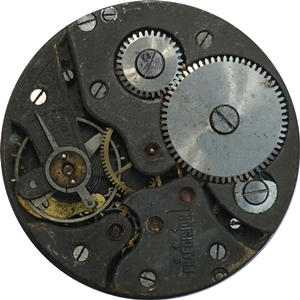
The movement shown above immediately catches the eye with its somewhat rough-looking structure. This movement has already been cleaned. In its uncleaned state, after about 100 years, the plates and bridges are almost black:
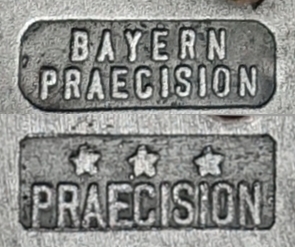
The wheel train bridge of the movements is marked either with BAYERN PRAECISION or with * * * PRAECISION:
My collection now includes five of these movements. I’ve only been able to get one of them working again. I tried cleaning another one in an ultrasonic cleaner, just as I do with other movements. This caused all the brass bearings to fall out of the mainplate and bridges. This has never happened to me with any other movement! Unfortunately, many parts cannot be interchanged between movements. For example, there are center wheels with slightly different axis diameters. And the movement plates also have slightly different diameters. So the movement parts could not be easily replaced with spare parts.
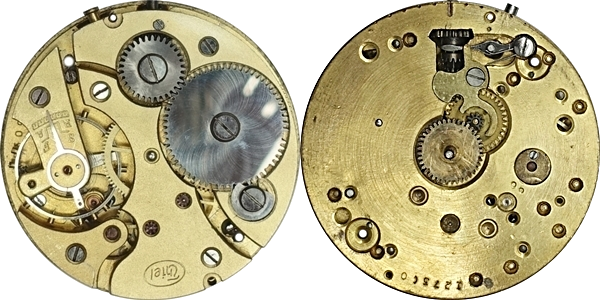
By the way, the similarities to the Thiela movement by Thiel are no coincidence, since Louis Wille had previously developed the Thiela in Ruhla!
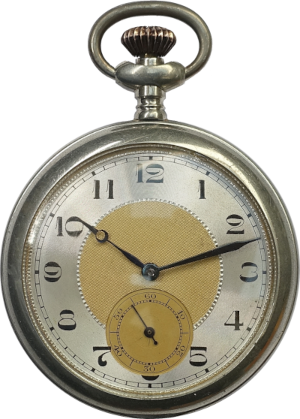
One of my Bayern Precision movements is mounted in this case, which features a classic Lépine (open face) design:
But the movements are also available in a Savonnette (hunter) case:
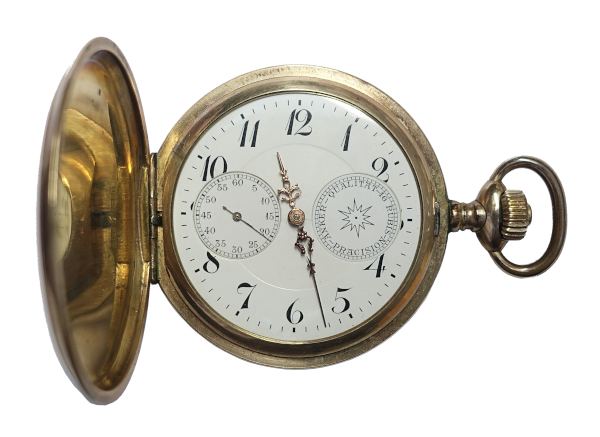
In a Savonnette movement, the small seconds hand should be at 6 o’clock. However, a Lépine movement was used here, which supports the assumption mentioned above that there was never a Savonnette version of the movement.
Presumably to conceal the supposedly incorrect position of the small seconds hand, the manufacturer placed a sort of logo at the 3 o’clock position:

The company is also said to have manufactured injection-molded pocket watch cases. Unfortunately, I haven’t seen any yet.
These watches and movements are quite rare. For one thing, the company was in business for only a short time; for another, the movements were apparently not very reliable in the long run. I suspect that most of the watches were simply thrown away at some point. Nevertheless, these watches and the injection-molded pocket watch movement from Bavaria remain fascinating historical artifacts!