Continue reading “Regulating a watch movement for beginners”
Uhrwerke – Eine Leidenschaft

Continue reading “Regulating a watch movement for beginners”
Every quartz watch has a jumping second, so the second hand always moves in whole second increments. This is in contrast to the mechanical watch, where the oscillation frequency of the balance determines how many small steps the hand takes between two second strokes. In classic movements, it’s 18,000 bph (beats per hour), which results in five steps per second; in the more modern 28,800 bph of an ETA 2824-2, it’s eight. This is called sweeping second.

Continue reading “A Dead Beat Seconds Movement – 140 Years old”
An inconspicuous ladies’ watch that holds a little surprise after opening the cover: an interesting plate whose inscription almost has the character of a novel – and a movement with Duplex escapement!

Continue reading “Waterbury Series L with Duplex Escapement”
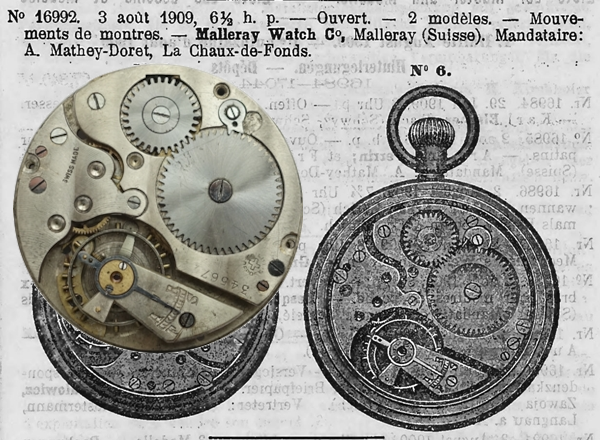
Catalogs for identifying watch movements exist from about 1930 on. The oldest catalog I know of is from Ebauches SA in 1928. But how can you identify even older movements?

Continue reading “Identifying Watch Movements with the Swiss Official Gazette of Commerce”
Sorry, this post is only available in German: Wie viele Steine benötigt ein Uhrwerk?

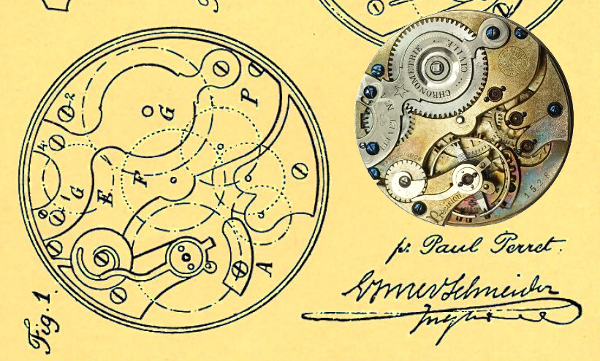
The Swiss Industrial Property Office (German: Eidgenössisches Amt für gewerbliches Eigenthum, French: Bureau Fédéral de la Propriété Intellectuelle) was founded on November 15, 1888, with headquarters in Bern, and started operations with only seven employees. Today it is called the Swiss Federal Institute of Intellectual Property (German: IGE = Eidgenössisches Institut für Geistiges Eigentum) and has about 300 employees.

The most famous employee of this office might be Albert Einstein, who started his service in July 1902 at the age of 23 as technical expert third class. But it should not be about him here!