
The history of the OSCO watch company is closely linked to the development of the German watch industry after World War II and reflects its rise, transformation, and structural crises.

About the Company’s History
The company was founded on November 1, 1948, by Otto Schlund in Schwenningen in the Black Forest, one of the most important centers of German watchmaking. He had trained as a watchmaker at the German Watchmaking School in Glashütte, where he graduated with several awards. He was the first to work on a wristwatch movement at that time.

The company name OSCO stands for Otto Schlund & Co. In the postwar period, demand for affordable wristwatches was high, and OSCO positioned itself from the very beginning as a manufacturer of reliable mechanical watches for everyday use. In the early years, the entrepreneur Robert Schlenker was also a partner in the company. However, by the mid-1950s, the company had become wholly owned by the Schlund family.

OSCO expanded significantly in the 1950s. The acquisition of a former Agfa plant in Villingen-Schwenningen enabled the company to expand its production. In addition to wristwatches, the company began manufacturing camera components — such as light meters — around 1960, and later even took over camera production for Agfa when the latter held a 75% stake in OSCO. This diversification was typical of many companies in the region that leveraged their expertise in precision engineering. At the same time, OSCO developed its own watch movements, which we will take a closer look at below.

Over time, OSCO established itself as a reliable manufacturer of mass-produced watches. Its products were regarded as functional, robust, and attractively priced. The company was part of the so-called Parat distribution group and also supplied other brands, such as Stowa. Thus, OSCO was active not only as a manufacturer of its own watches but also as a supplier within the German watch industry.

However, price pressure within the industry must have been enormous in the 1960s. OSCO attempted to establish its suggested retail price as a binding price and enforce it through pressure. For example, the company refused to declare its prices as non-binding retail prices. The Federal Cartel Office ruled against OSCO in this matter in 1961, and the Federal Court of Justice upheld this decision in 1963.
The company remained a family-run business: After the founder, the next generation — including Gerhard Schlund — took over management and continued to run the business for many years. In 1973, approximately 400,000 watches were manufactured by 150 employees. That same year, however, the company also announced that it would cease production of its own watch movements due to a lack of profitability.

As the global watch market underwent changes — particularly due to the so-called quartz crisis of the 1970s and increasing international competition — many traditional manufacturers came under pressure. OSCO, too, had to realign itself for the long term. In the early 2000s, the company was repositioned under the name Otto Schlund Zeittechnik by the founder’s grandchildren. New collections were launched, and the company increasingly relied on purchased movements from renowned manufacturers such as ETA. At the same time, the company sought to strengthen its ties with educational institutions, for example through its collaboration with the watchmaking school in Furtwangen beginning in 2005.
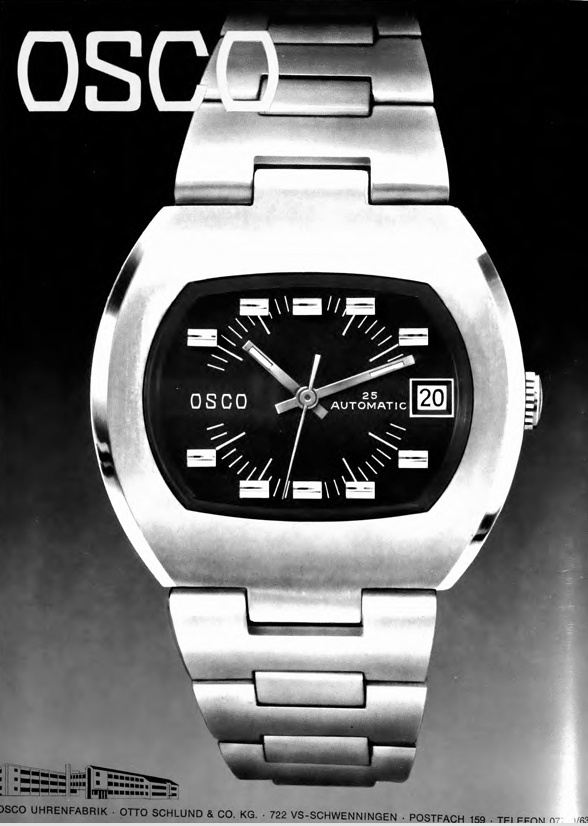
Despite these attempts at modernization, the company eventually faced significant economic difficulties. One of the key factors was the loss of major retail partners, including large department store groups such as Quelle, Hertie, and Karstadt, which had previously been key sales channels. This was compounded by financial problems and the termination of loans by the company’s primary banks. After the company’s headquarters were moved to Berlin in 2009, the company filed for bankruptcy as early as 2010. In 2013, the two managing directors at the time—the founder’s grandsons—were even sentenced to probation for delaying the filing of for bankruptcy and for bankruptcy-related offenses. OSCO employees had apparently not received any salaries since October 2009.
Today, the name OSCO continues to exist as OSCO Germany under UFS GmbH — founded in 2012 — with Axel Schlund as its managing director, and is associated in the company’s marketing with German watchmaking tradition and quality.
The company’s historical significance, however, lies in its role as a typical representative of the postwar German watch industry: a family-owned business that enjoyed decades of success thanks to its combination of skilled craftsmanship and industrial production, but ultimately could not withstand the profound structural changes in the market over the long term.
OSCO Watch Movements
Osco 42 And 42 CLD
Otto Schlund developed the first movement as early as 1942, but due to the war, it was not initially possible to set up production for it. Production did not begin until he founded his own company. A typical form movement for men’s watches. The movement shown here was also used by Dugena under its own caliber number, 550.
Technical data:
- Hand winding
- Size: 8 3/4 x 12´´´
- Small seconds
- Monometallic screw balance without shock protection
- Beat rate: 18,000 bph (half-oscillations per hour)
- 15 Jewels
- Rocking bar winding
- Click on the dial side

The movement is also available as caliber 42 CLD (Calendar) with a pointer date. The date module was likely developed somewhat later than the base movement. Due to the round module, the movement’s dimensions change to 11 x 12´´´.

Osco 50
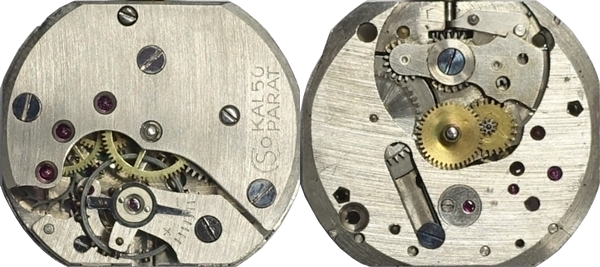
The second movement newly developed by OSCO was produced in 1950. It was also a form movement for men’s watches, but slightly smaller than the OSCO 42 and constructed using a simple pillar design rather than solid plates.
Technical data:
- Hand winding
- Size: 8 3/4 x 10´´´
- Small seconds
- Monometallic screw balance without shock protection
- Beat rate: 18,000 bph
- 15 Jewels
- Rocking bar winding
- Click on the dial side
Osco 52
In 1952, the OSCO 52 — a variant of the OSCO 50 featuring a directly driven central seconds instead of a small seconds —was introduced.
It’s quite obvious that the caliber designations listed so far have something to do with the year of their development!

Technical data:
- Hand winding
- Size: 8 3/4 x 10´´´
- Direct sweeping seconds
- Monometallic screw balance without shock protection
- Beat rate: 18,000 bph
- 17 Jewels
- Rocking bar winding
- Click on the dial side

Osco 53
The first small form movement for ladies’ watches from OSCO. The earliest reference I could find to it comes from the Flume K1 movement catalog in the 1957 edition. However, based on the caliber number, it may have been developed as early as 1953. Calibers 60 and 70, shown below, are closely related to the OSCO 53.
Technical data:
- Hand winding
- Size: 5 3/4 x 8 1/2´´´
- No seconds
- Nickel balance with shock protection
- Beat rate: 18,000 bph
- 17 Jewels
- Rocking bar winding
- Click on the dial side

OSCO 55 And 56
The first round OSCO movement for men’s watches. The only difference between the two movements is the number of jewels: 15 in the OSCO 55 and 17 in the OSCO 56. The OSCO 56 may well have been developed in 1956; the first reference to it appears in the 1957 part of the Flume K1, just like the Caliber 53. However, the OSCO 55 was likely not created in 1955, but rather after the OSCO 56. The first reference to it appears in the 1960 supplement to the Flume K1. The reduction in the number of jewels was likely a cost-saving measure.

Technical data:
- Hand winding
- Size: 10 1/2´´´
- Small seconds
- Gold-plated (?) nickel balance with shock protection
- Beat rate: 18,000 bph
- 15 (OSCO 55) or 17 jewels (OSCO 56)
- Rocking bar winding
- Click on the dial side
OSCO 60 And 70
Another small form movement for ladies’ watches. It’s not actually a new development, but rather a reissue of the OSCO 53. Like the 53, the OSCO 60 features a pillar construction, while the OSCO 70 has solid plates. Whereas the Caliber 53 has a single bridge for both the wheel train and the barrel, the OSCO 70 has two separate bridges.
And how does the OSCO 60 differ from the OSCO 53? Unfortunately, I don’t know, since I haven’t yet found a single movement that is clearly marked as an OSCO 60. The well-known movement catalogs only show the dial side of the movements, but not the bridges. On the dial side, both movements are identical. I suspect that the OSCO 60, like the OSCO 70, has two separate bridges. If this isn’t the case, it’s likely just a renamed OSCO 53.
With the OSCO 60 and 70, the logic that the caliber number corresponds to the year the movement was developed also comes to an end. In fact, both are already listed in the 1957 edition of the Flume K1!
Technical data:
- Hand winding
- Size: 5 3/4 x 8 1/2´´´
- No seconds
- Nickel balance with shock protection
- Beat rate: 18,000 bph
- 17 Jewels
- Rocking bar winding
- Click on the dial side

OSCO 65, 66 And 66D
The second round OSCO movement for men’s watches and the first with direct sweeping seconds. The caliber 66D features a date display, while the calibers 65 and 66 do not. The OSCO 65 and the OSCO 66 are both available in four variants:
- Setting lever with pin or screw
- With solid bridges or pillar construction
It seems that the only way to identify these movements is by their hallmarks. The first reference to the three movements can again be found in the 1957 part of Flume K1.
The OSCO 65 has strongly bevelled edges, while those on the OSCO 66 are less strongly bevelled.
Technical data:
- Hand winding
- Size: 10 1/2´´´
- Direct sweeping seconds
- Nickel balance with shock protection
- Beat rate: 18,000 bph
- 19 jewels
- Rocking bar winding
- Click on the dial side


OSCO 67
OSCO’s first small, round movement for ladies’ watches. You could say it’s the little brother of the OSCO 65/66. The movement was featured in the ‘Neue Uhrmacher-Zeitung’ issue 15/1959.
Technical data:
- Hand winding
- Size: 8 3/4´´´
- Direct sweeping seconds
- Nickel balance with shock protection
- Beat rate: 18,000 bph
- 17 jewels
- Rocking bar winding
- Click on the dial side

OSCO 72 And 78
A new generation of small form movements for ladies’ watches. The two movements are technically identical, although the OSCO 72 is equipped with 17 jewels, while the OSCO 78 has only 10. The OSCO 72 is listed in the 1960 supplement to the Flume K1, while the OSCO 78 does not appear until the 1962 Flume K2.
Technical data:
- Hand winding
- Size: 6 3/4 x 8´´´
- No seconds
- Nickel balance with shock protection
- Beat rate: 18,000 bph
- 10 (OSCO 78) or 17 jewels (OSCO 72)
- Rocking bar winding
- Click on the dial side

OSCO 100 Family
An entire family consisting of five round movements for men’s watches:
- OSCO 100: small seconds, no date, without threads for movement retaining screws
- OSCO 107: small seconds, no date, with threads for movement retaining screws
- OSCO 108: no seconds, date, with threads for movement retaining screws
- OSCO 130: indirect sweeping seconds, no date, with threads for movement retaining screws
- OSCO 131: indirect sweeping seconds, date, with threads for movement retaining screws
These are the earliest references I was able to find for these models:
caliber 100 in the 1957 part of Flume K1, calibers 107 and 108 in the 1962 Flume K2, and calibers 130 and 131 in the 1969 Engelkemper catalog.
At the least, the OSCO 100 was on the market at the same time as calibers 65 and 66. Was the reason simply the different bridge design, or was it an attempt to produce a more cost-effective movement?
Some OSCO 107 movements are marked OS 100 on the dial side. These likely date from the transition period between calibers 100 and 107.
Technical data:
- Hand winding
- Size: 10 1/2´´´
- Small seconds (100, 107), no seconds (108), indirect sweeping seconds (130, 131)
- Nickel balance with shock protection
- Beat rate: 18,000 bph
- 8 or 15 jewels
- Rocking bar winding
- Click on the dial side
- Pillar construction
I can show the OSCO 100, the OSCO 108 and the OSCO 131 here.
The 100 and 108 do not have separate bridges for the barrel and the wheel train. The curved line is simply a recess in the 3/4 plate!


OSCO 200 And 201
Two more round movements for men’s watches with direct sweeping seconds. The OSCO 201 has a date display; the OSCO 200 does not. Both movements are listed in the 1962 Flume K2 catalog.
Technical data:
- Hand winding
- Size: 10 1/2´´´
- Direct sweeping seconds
- Nickel balance with shock protection
- Beat rate: 18,000 bph
- 17 jewels
- Rocking bar winding
- Click on the dial side
I can only show pictures of the OSCO 200 here. Actually, I’ve never seen a picture of an OSCO 201.

OSCO 300, 400, 500, 600
A family of movements in two sizes for men’s watches, in which OSCO has generously spaced the caliber numbers in increments of 100:
- OSCO 300: 10 1/2´´´, indirect sweeping seconds
- OSCO 400: 10 1/2´´´, small seconds
- OSCO 500: 11 1/2´´´, indirect sweeping seconds, date
- OSCO 600: 11 1/2´´´, small seconds, date
The OSCO 400 is already mentioned in the ‘Neue Uhrmacher-Zeitung’ from 1964, while the other movements are first mentioned in the 1969 Engelkemper catalog. Of course, this does not mean that they could not have been on the market before then.
Technical data:
- Hand winding
- Size: 10 1/2´´´ (300, 400) or 11 1/2´´´ (500, 600)
- Indirect sweeping seconds (300, 500), small seconds (400, 600)
- Nickel balance with shock protection
- Beat rate: 18,000 bph
- 17 or 21 jewels
- Rocking bar winding
- Click on the dial side
- Pillar construction
You can see the OSCO 300, the OSCO 400 and the OSCO 600 here:


As with the OSCO 100 family, these movements also features a bridge variant where a curved line suggests separate bridges for the mainspring barrel and wheel train. In reality, however, this is merely a recess in the 3/4 plate!

OSCO 800 And 850
Unlike all OSCO movements shown so far, the ratchet wheel and click are mounted on the bridge side here. The OSCO 850 is the version with date display, while the OSCO 800 does not have one. Both feature a directly driven central seconds hand and an indirectly driven minute hand. And for the first time in an OSCO movement, they feature a winding mechanism without rocking bar. However, the movements do not have solid plates but are constructed using a pillar design. They were introduced in 1968 in the magazine ‘Die Uhr’.
Technical data:
- Hand winding
- Size: 11 1/2´´´
- Direct sweeping seconds and indirect minutes
- Glucydur balance with shock protection
- Beat rate: 18,000 bph
- 17 or 21 jewels
- Keyless works without rocking bar
- Ratchet wheel and click on the bridge side


OSCO 1060 Family
This family of movements for men’s watches consists of four members, including OSCO’s first and only automatic movement:
- OSCO 1060: hand winding, no date
- OSCO 1062: hand winding, date
- OSCO 1064: automatic, date
- OSCO 1065: automatic, no date
Although these movements have the highest caliber numbers among all OSCO movements, they are by no means the most recent ones produced by OSCO! All four are listed in the 1960 supplement to the Flume K1 catalog, and the 1060 and 1065 are also listed in the 1959 Feilner catalog.
Technical data:
- Hand winding or automatic
- Size: 10 1/2”’ (1060, 1062), 11 1/2´´´ (1064, 1965)
- Direct sweeping seconds
- Nickel balance with shock protection
- Beat rate: 18,000 bph
- 17 (hand winding) or 25 (automatic) jewels
- Keyless works without rocking bar
- Ratchet wheel and click on the bridge side

The automatic mechanism is screwed onto the base movement as a single module. The rotor winds the mainspring in both directions of rotation. During manual winding, the automatic mechanism is disengaged.


Utility Models of OSCO
Otto Schlund apparently did not file any patents, but he did file a number of utility models. Here, we will limit ourselves to those related to watch movements. In addition, he also filed some in the field of photography.
- DE1639984U: Armbanduhr mit kraftschlüssiger Zentralsekunde (Wristwatch with a force-fitting central seconds hand) (1952)
The image in this utility model clearly shows an OSCO 52.
In fact, this utility model is not about the central seconds, but about the rocking bar winding mechanism!

- DE1639985U: Armbanduhr mit kraftschlüssiger Zentralsekunde (1952)
The same title as the previous utility model. Here, the focus is on the easy removal of the mainspring barrel. Again, the OSCO 52 is used as an example.

- DE1639986U: Armbanduhr mit kraftschlüssiger Zentralsekunde (1952)
The same title again. This time, it’s about the three-quarter-plate of the OSCO 52.

- DE1639987U: Armbanduhr mit kraftschlüssiger Zentralsekunde (1952)
The fourth and final utility model with the same title concerns the arrangement of the wheels for directly driven central seconds.

- DE1679915U: Uhr mit Federantrieb (Spring-driven watch) (1954)
This utility model concerns the bearing of the mainspring barrel.

- DE1959893U: Einrichtung in Armbanduhren zum zwangsweisen Ausrücken der Wippe aus der Zeigerstellage (A mechanism in wristwatches for forcibly disengaging the rocking bar from the hand-setting position) (1967)
